


























Accuracy is crucial, as it describes the ability of a measuring instrument or a machine to deliver values that are near to the true value. In manufacturing environments, accuracy assessment tools play a key role in qualifying production processes. To achieve this, the machine capability indices Cm and Cmk in manufacturing are often mentioned in connection with accuracy. These indices were established in the automotive industry as a method of assessing the quality and suitability of power tools – today, they are broadly referenced as part of the machine capability index approach.
General Industries
Aerospace
Data centers
Automotive
New energy vehicles
Machine capability index: Reference for accuracy assessment
What is the difference between machine capability index Cm and Cmk?
- The first machine capability index (Cm value) is a crucial index used to measure the general ability of the tool to produce the required quality at the operating point and to measure the inclusion of this dispersion within the tolerance of the client application. The Cm index illustrates the repeatability of the machine, in view of this tolerance, without taking any systematic errors into account. It is therefore a cornerstone of Cm and Cmk in manufacturing when validating tool consistency.
- The second machine capability index (Cmk value), in addition, indicates the difference between the operating point of the tool and the target value. In other words, it gives an indication of compliance with the required operating points. While Cm measures the machine's potential capability and its inclusion in the client application tolerance, Cmk also considers systematic errors, providing a more realistic assessment of accuracy under customer application conditions.
In general, a tool is considered performant when Cm is high and Cmk is close to Cm. If Cmk is significantly lower than Cm, this indicates that the tool is repeatable but not centered, and therefore requires an adjustment of its setting.
Example:
- Cm = 2.0 and Cmk = 1.9
Tool is high performing, well centered, and highly repeatable. - Cm = 2.0 and Cmk = 1.2
Tool is repeatable but misadjusted: low dispersion, but the mean is shifted. - Cm = 1.5 and Cmk = 0.8
Tool is unstable and off center: both too much dispersion and poor centering relative to the target
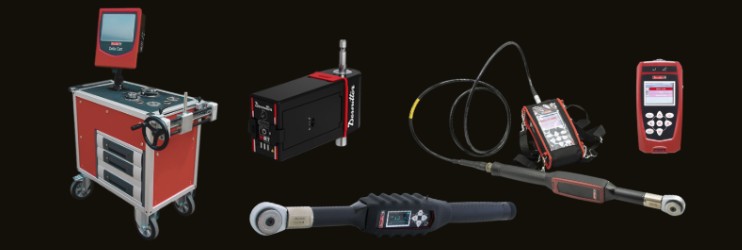
Discover our Torque Measurements System Solutions, for enhanced accuracy and repeatability
What is the target machine's capability to ensure accuracy?
The lower the dispersion in relation to the specified range, the higher the Cm value and the more reliable the production process becomes.
In other words, if you throw three darts at the board, they will always hit a specific field, but this will not always be the bull’s eyes. If the machine is set precisely to the center of the specified range, the Cmk value will be equal to the Cm value. As the setting moves away from this center, the Cmk value decreases. The objective is to achieve Cm and Cmk values that are as high as possible.
Cm – Quick interpretation:
High Cm = low dispersion = highly repeatable tool
Low Cm = high dispersion = unstable tool
Typical target values in the industrial tightening sector:
Cm ≥ 1.67: Very good
Cm ≥ 2.0: Excellent
Cmk – Quick interpretation:
Cmk is always ≤ Cm.
If Cmk ≈ Cm: the tool is well centered on the target value.
If Cmk << Cm: the tool is repeatable but poorly adjusted (torque offset).
Typical target values in the industrial tightening sector:
Cmk ≥ 1.33: Acceptable
Cmk ≥ 1.67: Very good
Cmk ≥ 2.0: Excellent
To illustrate this point, explore these diagrams with the dartboards explaining 3 different situations.
Low Cm value and low Cmk value

The nutrunner delivers a different result for almost every tightening.
High Cm value but low Cmk value

With reference to a nutrunner this would mean that the unit worked with high repeatability but always achieved the wrong results.
High Cm value and high Cmk value

In this particular case, the nutrunner always delivers the correct result with high repeatability and is always within the specified torque range.
A high Cmk value can only be reached with a high Cm value!
Related articles you would be interested in
General Industries
Aerospace
Data centers
Automotive
New energy vehicles

Quality assurance: Norms and standards you need to know
Norms and standards are a major dimension to take into account for quality assurance and industrial production. Read this reminder about the main quality assurance standards and industrial production norms to which you may be required to comply.
General Industries
Aerospace
Data centers
Automotive
New energy vehicles

Quality Assurance in Assembly: Measurement, Calibration and Traceability
Measurement and analysis are essential for reliability, safety, and product liability. See why these steps are critical and how they help guarantee quality in bolted assembly tools.
General Industries
Aerospace
New energy vehicles
Automotive


Taking quality control in torque management to a new level! Discover WRT
Desoutter has been working on a solution that will greatly simplify torque management, make data capture more reliable, and take quality control to a new level of efficiency. The result is our new Wireless Rotary Torque Transducer (WRT), which offers a simpler way to achieve tool verification or calibration without the need for cabling or any software. Indeed, this little black box, torque sensor, is all you will need to calibrate a whole range of tools, including click-wrenches, slip-wrenches, pneumatic tools, nutrunners and even Pulse tools.