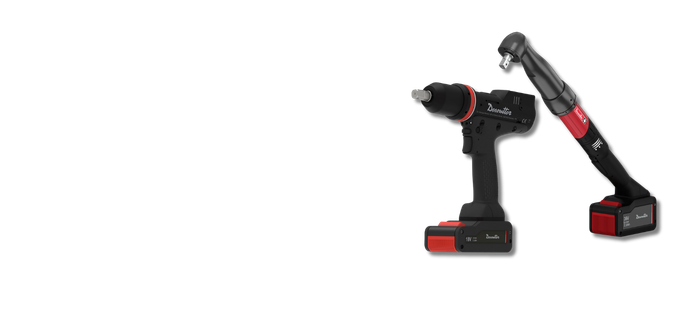
Designed for industrial assembly where speed, ergonomics and production stability matter, ePULSE nutrunners use a fully electric, oil‑free pulse technology to deliver high‑speed, controlled tightening without reaction arms — from low‑torque stations to high‑torque applications.
Range overview
• Battery pulse pistols: 6–80 Nm, up to 4000 rpm
• Battery pulse angle head: 40–110 Nm, up to 1300 rpm
Oil pulse downtime limits availability
Oil changes, heat sensitivity and servicing interruptions disrupt line continuity and reduce production availability. ePULSE replaces conventional oil pulse tools with an oil‑free mechanical gearbox, eliminating oil‑related downtime and ensuring stable operation across shifts.
Takt time pressure keeps increasing
Slow tightening directly impacts cycle time and overall output. With rotational speeds up to 4000 rpm, ePULSE shortens tightening cycles where takt time is critical, helping maintain production targets without compromising tightening control.
High torque complicates operator safety
Reaction arms add cost , instalation complexity, spatial constraints and operator fatigue at the station. Pulse tightening up to 110 Nm without reaction arms simplifies workstation design while reducing physical strain on operators.
Joint behaviour varies across assemblies
Assemblies combining hard and soft joints require adaptable tightening strategies. Progressive Pulse adjusts pulse behaviour to joint stiffness, maintaining stable tightening across varying assembly conditions.
Discover in video the ePULSE range: Pulse electric pistol screwdrivers and angle head nutrunners
The ePULSE range is designed with:
Oil free electric pulse technology: A fully electric pulse system using a mechanical gearbox design — no oil chamber, no hydraulic pulse unit, no oil temperature influence.
DynaPULSE productivity control: A patented algorithm synchronising pulse delivery to optimise efficiency and reduce tightening time on demanding production lines.
Progressive Pulse strategy: A tightening strategy extending pulse suitability beyond traditional hard joints, improving performance on softer or mixed joint applications.
One hand Electric Pistol Screwdriver from 6 Nm to 80 Nm
Instead of oil pulse unit, with over 5 times lower maintenance costs
Measure the torque directly, for better accuracy
*For BLRTC models
Compatible with both 18V and 36V battery
For contactless and easy pairing
For programmation and tightening results like torque, angle, batch count, pulses
To maximize the real-time feedback
To illuminate the application and provide real-time feeback directly on the parts
Instead of oil pulse unit, with over 5 times lower maintenance costs
Measure the torque directly, for better accuracy
*For BLRTC models
Compatible with both 18V and 36V battery
For contactless and easy pairing
For programmation and tightening results like torque, angle, batch count, pulses
To maximize the real-time feedback
To illuminate the application and provide real-time feeback directly on the parts
Angle Head Nutrunner from 40 Nm to 110 Nm
40 to 110 Nm with one tool only
Instead of oil pulse unit, to decrease maintenance cost
For contactless and easy pairing
Powered by Lithium Ion technology-36V
Measure the torque directly, for better accuracy
*For EABCLRT models
To maximize the real-time feedback
For programmation and tightening results like torque, angle, batch count, pulses
40 to 110 Nm with one tool only
Instead of oil pulse unit, to decrease maintenance cost
For contactless and easy pairing
Powered by Lithium Ion technology-36V
Measure the torque directly, for better accuracy
*For EABCLRT models
To maximize the real-time feedback
For programmation and tightening results like torque, angle, batch count, pulses
Electric pulse tools Key figures at a glance
Angle head - Up to 3 times faster than standard solutions
Pistol - Highest speed on the electric oil free pulse technology
Total torque coverage
Capability +/- 10% at 110 Nm
Duty cycle can be increased up to 60% compared to oil pulse unit
Use pulse fastening tools where high speed, high torque and operator comfort must coexist — without compromising production stability.
Typical applications include: Chassis assembly, axles, powertrain, engine assembly, strut mounting, fuel systems, battery pack rework and general industrial assembly.
Industries served: Automotive, transportation, rail, heavy equipment, energy and industrial manufacturing.
With ePULSE, your operators can tighten at high torque without a reaction device.
Thanks to the patented ErgoShield gearbox design, pulse time is reduced by up to five times, which lowers the torque reaction felt at each pulse — improving comfort, operator acceptance, and overall productivity.
Discover the complete range: Pistol and angle versions

Partners since decades
7 key aspects to keep in mind
PULSE screwdriving technology delivers short, repeated torque pulses to the assembly, while reducing the torque reaction transmitted to the operator, thereby minimizing the risk of fatigue and injury.
There are many advantages to pulse technology, the main ones are: There is no reaction force, so the tool is easy to operate without a reaction device. It also reduces the TCO as there is no need for a complex reaction system. The speed of the Desoutter PULSE tools is high, which increases productivity and efficiency.
The main difference between electric and oil pulse fastening tools lies in the pulse generation system. Oil pulse tools use a hydraulic oil chamber to generate torque, while electric pulse tools rely on a fully electric, oil‑free mechanical gearbox, delivering stable tightening performance without oil‑related heat, maintenance, or viscosity issues.
Hydraulic pulse tools use a pulse mechanism involving fluid. This technology requires regular and highly specific maintenance to ensure consistent performance. Desoutter's technology, which uses a specific mechanical gearbox, does not require an oil pulse unit, significantly reducing the maintenance costs.
Oil pulse tools require regular oil changes and are sensitive to temperature, which can impact tightening consistency, increase downtime and raise lifecycle costs.
A high‑torque pulse tool is designed for production lines where elevated torque levels must be achieved at high speed without reaction arms. By delivering torque through controlled pulses, electric pulse tools enable stable tightening results, reduced operator fatigue, and simpler workstation design in high‑volume industrial assembly.
The best pulse screwdriver without a reaction arm is an electric pulse screwdriver designed for production lines, where torque is delivered through controlled pulses instead of continuous force. This allows high‑torque tightening without reaction arms, reducing operator strain while maintaining high speed and stable results. Electric, oil‑free pulse tools such as ePULSE are specifically developed for repetitive, high‑volume industrial assembly where ergonomics and workstation simplicity are critical.
An electric pulse nutrunner (also called a pulse screwdriver or pulse fastening tool) is a tightening tool that uses a pulse-based mechanical system to deliver high torque with low reaction force, making it suitable for high-speed industrial assembly without reaction arms.
Pulse tools are traditionally best suited for hard joint applications, but modern electric pulse tools can also be used on soft joints when equipped with adaptive tightening strategies. Technologies such as Progressive Pulse dynamically adjust pulse energy to joint stiffness, enabling controlled tightening on soft and mixed joints with greater consistency.
Pulse nutrunners prioritise speed and low reaction for operator comfort, while DC electronic nutrunners prioritise maximum tightening control, precision, and built-in traceability.
Pulse tools are typically best suited to hard joint applications. Desoutter has developed a motor control mode called 'progressive pulse', which enables the ramp-up to the final pulse amplitude and can also be used for softer joints.
It is possible to use PULSE technology for low torque application. Then Pistol PULSE tools are often used. At Desoutter, we have a range of pistol pulse tools starting at 6Nm.
As with electric direct drive tools, pulse technology is available with batteries and cables. This gives our customers the choice of power technology depending on their application type.
No. Productivity depends on pulse control. ePULSE uses the patented DynaPULSE algorithm to optimise pulse efficiency and reduce tightening time on demanding applications.
Yes. The ePULSE range covers 6–110 Nm, with pistol tools from 6–80 Nm and angle head tool from 40–110 Nm.
Yes. Progressive Pulse adapts tightening behaviour to joint stiffness variations, making it suitable for assemblies combining hard and softer joints.
Yes. The range supports stand‑alone feedback or full traceability when connected through the CONNECT ecosystem.